Proof
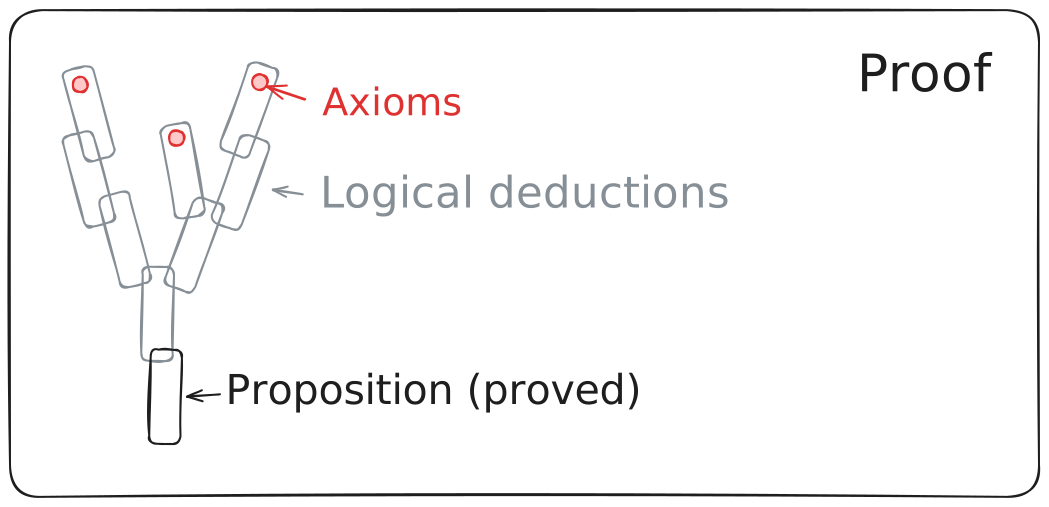
A mathematical proof is a verification of a proposition by a chain of logical deductions from a base set of axioms.
Proposition
A proposition is a statement that is either true or false.
Predicate
A parameterized statement that is not yet a complete proposition. It usually expresses a property of an object, or a relationship between objects.
Logical deductions
Propositions can be combined using Boolean Logic Gates to form new propositions. An inference rules is a rule for combining true propositions to form other true propositions.
Common inference rules
Modus Pones: if then [see implication]
Contrapositive: [see contrapositive]
Axiom
An Axiom is a proposition we assume is true.
A set of axioms is consistent when you can’t prove that false is true.
A set of axioms is complete when every true proposition can be proved from the axioms.
Gödel’s Incompleteness
Gödel’s Incompleteness theorem proved that you can’t have both (complete and consistent) as long as it’s complicated enough to do arithmetic.
Proof outlines
Theorem:
Proof: Choose then because and is true because
Theorem:
Proof: Suppose is a generic element of . Then is true because
Theorem:
Direct Proof: Assume then is true because
Proof by contrapositive: Proof by Contrapositive, assume is false. Then is false because
Theorem:
Proof: For sake of contradiction, assume is false …… Then is both true and false, contradiction. (So our assumption is wrong, is true)
Proof by 2 Cases
- take any proposition
- is tautology
- show is equivalent to
- then
Theorem: P
Proof: Proof by cases on the truth value of
- Case 1: is true (ie. assume is true)
- then is true because
- Case 2: is false
- then is true because
is either true or false cases are exhaustive
Theorem: is true
Assuming is a tautology
Proof: Proof by cases
- Case i: is true (assume ) then is true because
Cases are exhaustive because
Principle of induction
Proof by Strong Induction
if
then
This is very useful in recursive proofs, where you break down a problem into multiple recursive parts.
Theorem:
Proof: by strong induction
- assume
- WTS , by cases
- base cases: because
- induction step: assume n > b then because
Common Abbreviations
WTS: Want to show
QED: That which was to be demonstrated (quod erat demonstrandum)